

As consumers and businesses adopt real-time and other modern payment methods, fraudsters are using AI and automation to take advantage of gaps in defenses. Merchants and acquirers need to stay ahead of fraud and protect their customers while driving growth with added complexity.
How is AI changing the fraud landscape?
Payments have seen more change in the past 15 years than throughout the previous century. We've seen cash make way for cards, followed by digital wallets, and now real-time payments (RTP) are becoming the norm.
For consumers and businesses alike, digital-first payments offer speed and convenience—but they also create new risks and challenges, as each advancement opens the door to new or increased fraud opportunities. For example, RTP fraud is already a top-five fraud trend in Asia Pacific (the other four being card testing, account takeover (ATO), first-party misuse (or friendly fraud), and refund/policy abuse).
And as payment rails diversify, the fraud landscape becomes more dynamic and complex, and traditional fraud models that were built for card-based transactions are no longer as effective.
Fraudsters have always been quick to adapt their tools and techniques, constantly testing and using automation to identify gaps in businesses' defenses. They're now rapidly adopting new technology such as GenAI to create synthetic identities, produce deepfake authentication, and deploy automated bot-driven attacks that convincingly mimic real customers. These AI-driven attacks are picking up the pace, and it's expected that GenAI-enabled fraud will keep rising over the coming years.
This rapid evolution has clear implications for merchants and acquirers:
- Fraud cycles are becoming much shorter and more complex.
- Manual reviews and static rules-based systems are no longer up to the job.
- Fraud is now evolving too fast, too dynamic, and too intelligent for legacy approaches.
What challenges do merchants and acquirers in Asia Pacific face?
As digital commerce expands, card-not-present (CNP) fraud has become more sophisticated. In Asia Pacific, the CNP fraud rate is 9% higher than the card-present (CP) rate;1 25% of consumers in the region say they've experienced online fraud.2
Merchants and acquirers in the region may feel underequipped to face the challenges of this complex fraud landscape. They tell us that:
- More than 50% are struggling with resourcing and operational efficiencies.3
- 3% of total eCommerce revenue is lost to fraud each year as merchants still struggle with effectively using data, improving accuracy and dealing with gaps in what their fraud tools can do.3
- Infrastructure and resourcing constraints limit fraud effectiveness.
- Manual reviews contribute directly to false declines, which can result in lost sales and erode customer trust and loyalty.
How can merchants and acquirers combat AI-driven fraud?
To combat fast-moving AI-driven fraud, businesses need AI-powered, real-time fraud detection solutions that can instantly distinguish good customers from bad actors and continuously learn from behavior across devices, channels, and geographies. Behavior-based intelligence is a critical part of this approach. It helps systems identify subtle anomalies before they turn into losses, while still approving trusted customers with minimal friction to reduce the likelihood of false declines that can impact growth and profitability.
But there’s a catch: not all AI is created equal. Many fraud prevention solutions on the market claim to use AI, but the effectiveness of an AI-powered fraud solution depends on scale, data quality, and continuous learning—all areas where Visa stands out.
Why can you trust Visa for AI-powered fraud detection?
We've been applying AI to payments for more than three decades, making us pioneers long before AI became the industry buzzword it is today. And we haven’t slowed down. On the contrary: over the past five years we've invested $12B in technology,4 with $3B dedicated to AI.5 To be clear, we're not talking about adding AI on top of existing tools—we're investing in deeply embedding AI into our risk scoring models, automation capabilities, and fraud-‑prevention platforms.
Our investment is complemented by the billions of global transactions analyzed by our risk scoring models each year to provide unique insights into global fraud patterns. As a result, our AI can adapt quickly, detect subtle fraud patterns, and deliver more accurate decisions that help merchants and acquirers:
- Manage fraud before and during payment authorization.
- Minimize false declines.
- Deliver a friction-free experience for genuine customers at every touchpoint.
How does Visa’s AI-powered Decision Manager deliver real-time fraud prevention?
Decision Manager is designed to help you stay ahead in today's world of fast, complex, and relentless online fraud. It combines our advanced AI and global data with flexible controls in a single, powerful platform. Built to deliver smarter, faster, and more precise fraud prevention at scale, Decision Manager detects and prevents fraud in real time across the entire payment journey—from pre-authorization to post-authorization. Instead of applying static rules, you’re deploying a self-learning AI that evolves with fraud trends—continuously adapting without manual retraining to help you stay ahead.
Here are just some of the ways in which Decision Manager stands out:
- AI at the core with XGBoost, one of the most advanced ML algorithms optimized for payments to detect imperceptible fraud patterns.
- Unmatched scale trained by screening 628B transactions annually,7 delivering real-time risk scores in milliseconds.
- Precision and adaptability to help spot risky patterns—even if it’s the first time fraud hits your store—while approving more good customers.
- Enabling growth beyond stopping fraud by helping you reduce false declines, improve customer experience, and cut operational overhead.
How does layered intelligence keep you ahead, always?
What takes Decision Manager to the next level is the way it combines layers of intelligence to keep you ahead of fast-changing fraud. This layered approach gives you deeper context, greater precision, and full control—exactly when you need it—so your fraud strategy can evolve as fast as the threats you face.
Layer 1: AI-powered risk scoring. This detects complex fraud patterns in milliseconds by analyzing vast amounts of data in Visa’s global networks. It allows you to confidently approve more good customers without slowing them down, even during high-volume or high-risk periods.
Layer 2: Dynamic identity signals. Instead of relying on static data, Decision Manager analyzes how an identity (or individual) behaves across time and channels. It looks at indicators like email address, device, IP address, and velocity patterns to spot synthetic or compromised identities.
Layer 3: Custom business parameters. Every business has its own risk appetite, operating models, and customer experience goals. Decision Managers gives you the flexibility to customize policies so that your fraud strategy aligns with your goals—rather than relying on a one-size-fits-all model.
These layers work together, supported by Visa’s data science teams who continuously finetune and optimize the models. The result is decisioning that’s fast, scalable, and aligned with real-world behavior and emerging threats.
The proof is in the numbers: merchants using automation achieve a 97.8% acceptance rate.8 That means faster approvals, fewer false declines, and minimal operational overhead—all while keeping fraud under control.
What does Decision Manager's dashboard offer?
The KPI dashboard, one of our recent innovations, gives you unified visibility into approvals, declines, and fraud rates in real time. AI-powered insights help you identify the root causes of performance changes in seconds, while GenAI-driven case summaries simplify investigations, making fraud resolution faster and smarter.
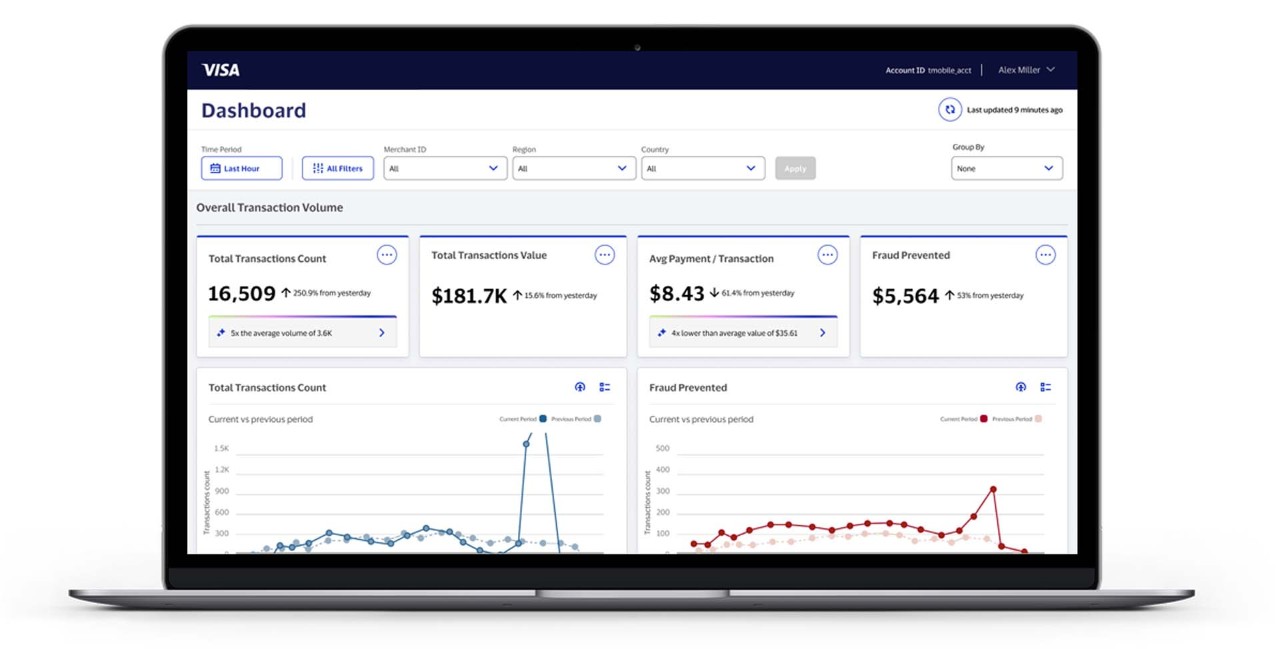
Decision Manager's KPI dashboard
Ready to learn more about AI-powered Decision Manager?
Decision Manager transforms identity signals and behavioral data into actionable intelligence, applying AI across multiple fraud use cases through a system of models, rules, and signals to drive smarter, faster, and more accurate decisions. Learn how Decision Manager and Visa’s other fraud and risk management solutions can help your business stay ahead, always.
Want to learn more on how to outsmart fraudsters in the age of AI? Watch our on-demand webinar here.
1 Estimate based on Apr 2022 – Mar 2023 VisaNet data for Asia Pacific.
2 yStats, Fraud and Security in Global Online Payments, February 2024.
3 MRC 2024 Global Fraud Report, conducted from October to December 2023, surveyed 1,166 eCommerce fraud and payment management merchants (including 147 MRC members) from 37 countries. The report covers various revenue tiers, sales channels, and eCommerce categories.
4 Visa global financial data FY20-FY24.
5 30 years of AI and counting, Rajat Taneja, President of Technology, Visa, 14 September 2023.
6 Forrester does not endorse any company, product, brand, or service included in its research publications and does not advise any person to select the products or services of any company or brand based on the ratings included in such publications. Information is based on the best available resources. Opinions reflect judgment at the time and are subject to change. For more information, read about Forrester’s objectivity here.
7Represents the value of payments processed through Decision Manager in the 2024 fiscal year. Normalized for USD.
8Percentages calculated based on data collected from all clients using Decision Manager between 1/12/24 to 12/31/24.